

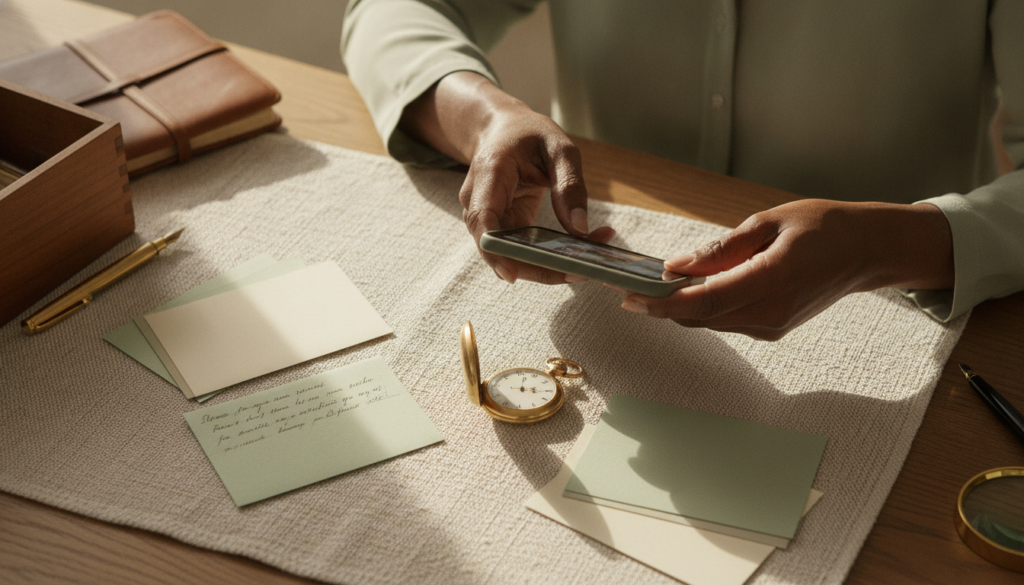
The short answer: Write a short note for each heirloom that names who owned it, where it came from, and why you kept it, then keep the note with the item or in a belongings catalog. That’s what stops your children from arguing over who gets what: an appraisal tells them what something is worth, and the note tells them why it mattered.
A provenance note is a short written record of an heirloom’s origin and meaning: who owned it, how it entered the family, and why it was kept. It’s separate from an appraisal, which records only what the item is worth.
Why do families argue over belongings more than money?
Because personal possessions can’t be split evenly the way a bank account can. In Allianz’s 2005 American Legacies Study of 2,627 boomers and elders, adult children named two things as the greatest source of conflict after a parent’s death: distributing personal possessions, and fulfilling last wishes.
| Source of conflict after a parent’s death | Share who named it |
|---|---|
| Distribution of personal possessions | 15% |
| Fulfilling last wishes | 15% |
| Distribution of finances | 3% |
The researchers point to why: personal items are, unlike money, unique. Two siblings can split a savings account, but not their mother’s wedding ring, and many adult children connect these objects to their fondest childhood memories or a parent’s love.
What gets lost when the story isn’t written down?
The memory attached to the object, which is usually the part everyone wanted to keep. The same Allianz study found only 8% of boomers and 3% of elders named family traditions, rituals, and stories as the single most important thing to pass on, even though undocumented sentimental possessions became the very thing families fought over most.
A 2021 review in Current Opinion in Psychology by van den Hoven, Orth, and Zijlema found that the link between a possession and the memory it holds can become lost over time, tied specifically to aging and forgetting around heirlooms. Once the person who could tell the story is gone, the object is just an object.
What should a heirloom note include?
The Smithsonian Center for Folklife and Cultural Heritage’s oral history guide recommends a simple format for documenting family photos and objects, called a photo log: record the item’s subject matter, date, and location. Applied to an heirloom, that’s four things.
- What it is: the object, plainly described (a pocket watch, not “grandpa’s watch”)
- Where and when it came from: the date, place, or occasion it entered the family
- Who it’s connected to: the person who owned it, and who it’s meant for now
- Why you kept it: the story, in your own words or theirs
The last point is the one people skip. The Smithsonian guide notes these stories “encapsulate attitudes and beliefs, wisdom and knowledge that lie at the heart of a person’s identity and experience,” best recorded while the storyteller is still around. If your parents hold them, our guide on how to talk to your parents about end-of-life planning has questions to start that conversation.
Where should the note live so it doesn’t get lost?
Not in your head, and not on a sticky note in a drawer. Most people who take this seriously keep a running belongings catalog: one list, item by item, pairing each object with its recipient and its story.
A 2026 survey of 1,200 U.S. adults for 1-800-GOT-JUNK’s Great Junk Transfer study found 49% would rather inherit nothing than sort through a relative’s belongings. When people do choose what to keep, they favor items tied to memory, identity, or family history over volume, which a belongings catalog sorts out in advance.
Does a heirloom note carry any legal weight?
In California, yes. Probate Code section 6132 lets a will refer to a separate, signed and dated list disposing of tangible personal property, as long as it stays inside two caps and describes each item and recipient “with reasonable certainty.”
| California Probate Code section 6132 cap | Limit |
|---|---|
| Total value of items on the list | $25,000 |
| Value of any single item | $5,000 |
The list is different from the note: it’s a legal instruction about who gets what and must meet a court’s standard; the note is the story of why. Anything left off it falls into your residuary estate, distributed under the general terms of your will. Other states set their own rules for lists like this, so check what applies where you live.
What about heirlooms valuable enough to matter for estate taxes?
If an heirloom is valuable enough, the story alone won’t satisfy the IRS. Form 706, Schedule F requires an executor to state whether the person who died owned art, an item, or a collection worth more than $3,000, and if so, attach a signed expert appraisal to the estate tax return.
Frequently asked questions
Do I need to write a note for every single item?
No. Focus on pieces with a real story: things that were made, chosen, survived something, or passed through more than one generation. A note for every possession in the house isn’t useful to anyone; a handful of well-documented heirlooms is.
What if I don’t know the full story behind an heirloom?
Write down what you do know, even if it’s incomplete, and note who might remember more. A partial note, such as “Grandma’s ring, she wore it every day, origin unknown,” is still far more useful to your children than nothing at all.
Should I write the note myself or ask the person who owned the item?
Ask them, if they’re still here to answer. The Smithsonian’s oral history guide recommends recording stories directly from the person who lived them, since the details and meaning belong to them, not to a version reconstructed later from memory.
Is a belongings catalog the same as a will?
No. A will, or in California its attached property list, legally decides who receives an item. A belongings catalog is a separate, informal record of the story behind each item, useful alongside a will but not a substitute for one.
None of this has to happen in one sitting. Start with the one item you’d grab first, write down what you know, and add the rest over time. It pairs naturally with the other things you leave behind, like a farewell message. The note takes minutes; the memory it protects doesn’t come back once it’s gone.
This article is general information, not legal, tax, or financial advice. Consult a licensed professional in your jurisdiction before relying on it for your own estate plan.
Last reviewed: August 2026