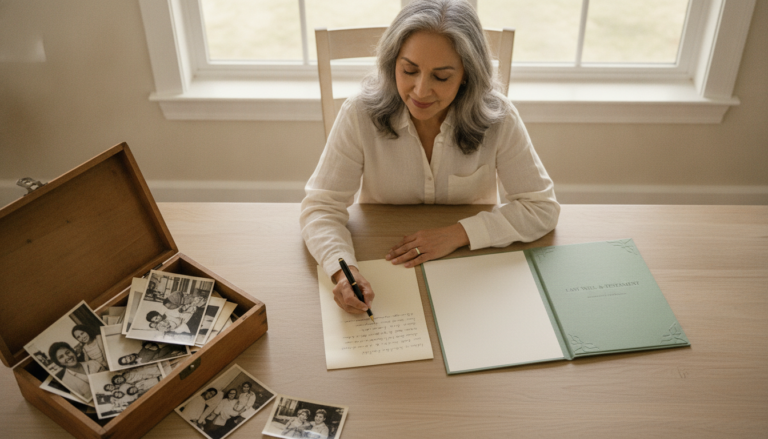


An obituary tells the people who did not know your person, and reminds the people who did, who they actually were, not just that they died. Learning how to write an obituary does not require being a writer; it requires the facts and one true memory, and the rest follows from there. This guide walks through six steps, a checklist of what to include, worked examples, and the mistakes worth avoiding: enough to get you from a blank page to something you’re comfortable sending, whether this is the first obituary you’ve written or the third.
If the person you love is still here, and you are looking for what to say to them directly, see comforting words for the terminally ill instead.
If the death is recent and the obituary is one of several things landing at once, what to do when someone dies lays out the first hours, days and weeks in order, with the obituary in its place among them.
How to write an obituary in 6 steps
Here is the whole process in outline. Each step is explained below, with an example.
- Start with the facts: full name, age, city, and date of death.
- Sketch the shape of their life: where they were born, where they were raised, and the chapters that mattered.
- Show who they were, not just what they did.
- Name the people who survive them, and who came before them.
- Add the practical details: the service, and where to send donations in lieu of flowers.
- Read it aloud, check every name and date, and let one more person read it before it goes anywhere.
Write the obituary
Six short questions, at whatever pace you have. Answer only what you can, and we write one complete draft you can hand to a funeral home or a newspaper.
What was their name?
The full name a notice would carry, and the name the people who loved them actually used.
Their age, or their years.optional
Either is fine: “84” or “1946–2026”. We will never ask how they died. That is yours to include or leave out.
Who do they leave behind?optional
Write it the way you would say it out loud. Names, in the order that matters to your family.
Only the names you write here will appear. We add no one.
What filled their life?optional
Pick what fits, then add one specific thing: the detail that makes it them and no one else.
Service details, if they are settled.optional
Leave any of this blank. You can add it to the draft later with one tap.
How should it read?
Newspapers usually want Short and Traditional. A funeral home notice can breathe more.
Writing the obituary. This takes a moment. There is no rush.
Check every name, date and place before you share this. We wrote it from your answers only, and accuracy here matters more than anywhere.
Email me this obituary, print-ready
Optional. The draft above is already yours. Copy it and close this page if that is all you need. The emailed copy is simply easier to print and hand to a funeral director.
These steps work in order, but nothing is final until the last one. Feel free to move a fact around, add a line, or cut one that does not fit as you go.
1. Start with the facts
Four facts are non-negotiable, and they go first: full name, age, city or town, and date of death. If they went by a nickname more than their given name, include both. Everything else in the obituary can wait; these cannot.
Cause of death is not on that list. It’s entirely optional, and it stays optional no matter who asks. Plenty of families choose a general phrase, or leave it out completely, and both are complete answers.
Some families also leave out the age entirely, particularly for someone who was private about it; that is a fine choice too, as long as it is deliberate rather than a guess. If the person used a different name at different points in their life (a maiden name, a name from an earlier marriage, a name they later changed), ask the family which one belongs here, since it is rarely an obvious answer.
Example: “Margaret Ellen Doyle, 78, of Springfield, Ohio, died on March 3, 2026.” Names in examples are fictional.
2. Sketch the shape of their life
Once the facts are down, give the outline: where they were born, where they grew up, their education, their marriage, their career, in a few sentences, not a résumé. This is the chronology, told briefly.
Move through it quickly. A paragraph per decade is too much; a phrase per chapter is usually enough, especially if you want room left for the part that actually sounds like them.
Not every chapter needs equal space. If someone spent forty years in one career and two in another, the obituary can reflect that imbalance instead of forcing false symmetry. The goal is a shape a reader can follow, not a complete timeline.
Example: “Margaret was born in Dayton, raised in Springfield, and spent forty years teaching second grade at the same elementary school she’d once attended as a child.”
3. Show who they were, not just what they did
A job title tells a reader what someone did. A story tells a reader who they were. An obituary that only lists achievements could describe almost anyone who held the same job.
Pick one trait, one habit, or one moment that actually captures them, and let it carry the section instead of a full list of hobbies and honors. Specific beats comprehensive, every time.
If more than one story comes to mind, pick the one that would make the people who knew them best nod in recognition, not the one that sounds most impressive written down. A small, specific memory almost always beats an achievement, even a real one. Humor belongs here too, if it was genuinely part of them: a funny habit is still a specific, true detail.
Example: “Daniel kept a harmonica in his shirt pocket for fifty years, and pulled it out, uninvited, at nearly every family gathering.”
4. Name the people
List survivors in order of closeness: spouse or partner first, then children, then siblings, grandchildren, and other close family. If the family wants it, add those who died before them too, usually introduced as “predeceased by.”
Relationship matters more than paperwork. A longtime partner, a stepparent who raised them, a chosen family member, or a same-sex spouse belongs on this list if the relationship was real, whether or not a form would ask about them. Use the words the family actually used for each other in life.
If the family relationships were complicated (an estrangement, a difficult divorce, someone the family has mixed feelings about), the obituary reflects what the immediate family wants written, not a strict accounting of who is technically owed a mention. This list is an act of care, not a legal record.
Many families are writing personal condolence notes to relatives around the same time; if that is you, sympathy messages for the loss of a mother and sympathy messages for the loss of a parent have ready lines to send alongside it.
Example: “She is survived by her husband, James Doyle; her children, Peter Doyle and Anne Whitfield; and four grandchildren. She was predeceased by her parents, Frank and Louise Hartley.”
5. Add the practical part
This is the section people actually scan for: the date, time, and location of the service, or a note that it is private or family-only. If the family has a preference for flowers versus donations, say so clearly, and name the organization if there is one.
Keep this part plain and skimmable. Short, factual sentences work better here than anywhere else in the obituary: this is instructions, not narrative.
A few smaller details round this section out if they apply: whether the service will be livestreamed for family who cannot travel, whether there is a separate visitation time before the funeral, and whether an online guestbook or memorial page exists for people who want to leave a message.
Example: “A memorial service will be held at 2 p.m. on Saturday, June 13, at First Presbyterian Church, 210 Main Street. In lieu of flowers, the family asks that donations be made to the Springfield Public Library.”
6. Read it aloud, then let someone else read it too
Reading aloud catches what the eye skips over: a missing word, an awkward rhythm, a name that trips on the tongue because it is not actually right.
Then check every detail against a record, not memory (a birth certificate, a marriage license, an ID), rather than what you are sure you remember. Pay particular attention to place names and less common spellings; autocorrect and easy assumptions both get these wrong more often than you would expect. This is the one place a small error becomes permanent: printed, archived, and searchable for years.
A second reader, especially someone who knew them, often catches a wrong date, a name left off the survivor list, or a sentence that just does not sound like the person you are describing.
If you would rather answer six short questions and start from a written draft, the free obituary writer below does exactly that. There are also 24 complete obituary examples to borrow from.
What to include in an obituary: the checklist
Use this as a final check before the obituary goes anywhere. Not every line applies to every family. Leaving one out on purpose is different from forgetting it.
- Full name: plus the name they actually went by
- Age and location: the city or town where they lived
- Date of death: the day is enough
- Birthplace and birth date: optional, common in longer obituaries
- Parents’ names: a line on where they came from
- Education or military service: one line, not a transcript
- Career or life’s work: what they did, briefly
- Marriage: spouse’s name, and the year if known
- One defining story or trait: the part that sounds like them
- Survivors: listed in order of closeness
- Predeceased by: only if the family wants it included
- Service details: date, time, place, or simply “private”
- Memorial gifts: where donations should go instead of flowers
- Faith or scripture line: optional, only if it matches their own beliefs
None of this is a legal requirement, and no two families will fill it out the same way. Some obituaries run long and warm; others are four lines in a newspaper’s classified section. Both do the job, as long as the facts are right and the person sounds like themselves.
How long should it be
Newspapers typically charge by length (the more words or lines, the more it costs), so for a printed obituary, budget is often what decides the final length, not sentiment. It’s worth knowing that before you start writing, not after. Rates vary widely by publication, so ask the newspaper directly rather than guessing.
- A short notice (roughly 50–100 words): the facts, survivors, and service details, nothing more.
- A standard obituary (roughly 200–300 words): the facts plus a short life story and a personal detail or two.
- A full tribute (400 words or more): the shape of a life, several stories, and a longer survivor list.
Length and timing are connected, too. Newspapers work backward from the funeral or service date, so a shorter notice that meets today’s deadline is sometimes the right trade against a longer obituary that would miss the print date entirely. If timing is tight, publish the short version now and consider a fuller one online, where there is no deadline to beat.
Online, none of this applies. Funeral home websites, memorial pages, and social media do not charge by the word, so length becomes a choice about the reader rather than the budget. It’s also the version relatives researching family history are most likely to find years from now, worth a thought if you’re deciding between a short notice and a fuller page. Say what needs saying, and stop there.
Obituary, death notice, eulogy: the difference
These three get used interchangeably, and they should not be.
| Term | What it is | Where it appears |
|---|---|---|
| Death notice | The bare facts: name, dates, service details. No life story. | Newspaper classifieds, usually paid by the line |
| Obituary | The story of a life: background, personality, survivors. | Newspaper, funeral home website, online |
| Eulogy | A spoken tribute, written to be read aloud. | Delivered at the service, not published |
Most families only need the first two: a notice for the facts, an obituary for the story, sometimes both printed for the same person. A eulogy belongs to a different moment entirely, spoken rather than published, and is not what this page covers. For that, see our guide to writing a eulogy, or draft one with the free eulogy writer.
In practice, timing often decides which one you need first. A death notice can go to the newspaper within a day, while the fuller obituary, the one with the story in it, can follow once there has been time to write it properly. Neither has to happen instantly, and getting the story right is worth more than getting it out fast.
What to leave out
Some of what does not belong is about protecting the family’s safety and privacy. Some of it is about protecting a memory. Here is what to leave off, and why.
- The exact cause of death, if you would rather not. You are never obligated to explain how someone died. “After a long illness” or no mention at all are both complete answers.
- A home address. Obituaries are public, and a published service time next to a home address is a known risk: empty houses during funerals have been targeted by burglars. Give the funeral home’s address for flowers or cards, never a private one.
- Anything they kept private. If they never told people about an illness, an estrangement, or a chapter of their past, the obituary is not the place to correct that. Let them keep what they chose to keep.
- Old scores. An obituary is not the venue for a complaint about who visited enough, or who was not invited to something. Whatever needs saying, say it somewhere else.
- Reflexive language that could describe anyone. “Passed away peacefully, surrounded by loved ones” is the default a search result or a template hands you, and it says nothing about the actual person. If it is true, a specific detail says it better than the cliché does: who was really in the room, what the last weeks were actually like.
None of this is about hiding the person you are writing about. It is about choosing, on purpose, what belongs in something that will be public, permanent, and read by people well outside the family: coworkers, distant relatives, and strangers doing the same search you might be doing right now for someone else.
Common mistakes
- Writing it like a résumé. A list of job titles and degrees says what someone accomplished, not who they were. A reader should finish the obituary knowing at least one thing about the person that no résumé would ever mention.
- Proofreading from memory instead of records. A wrong birth year or a misspelled maiden name is easy to miss when you already believe you know it, because you are reading what you expect to see rather than what is actually on the page. Check a birth certificate, a marriage license, or an ID.
- Leaving someone off the survivor list by accident. This is the mistake families remember longest, and it is almost always an oversight, not a snub, but it rarely feels that way to the person left out. Read the list aloud with another relative before it is final.
- Waiting for the right words. There is no perfect sentence that makes this easier to write. A plain, true paragraph beats a polished one that never gets finished.
- Copying a template obituary from a search result. Generic phrasing is easy to spot, and it says nothing about the person you are writing about. Borrow the structure, never the sentences.
- Publishing before a second reader sees it. A misspelled name, a missing detail, a sentence that reads wrong out loud: someone else will catch what you cannot, because you already know what it is supposed to say.
Frequently asked questions
Do you have to say the cause of death?
No. “After a long illness,” “unexpectedly,” or no mention at all are all complete and normal choices, and no one is owed an explanation. If the death was by suicide, how much to share is entirely the family’s decision. If you do write about it, the accepted phrasing is “died by suicide”; older wording that treated suicide as a crime is best avoided.
How much does it cost to publish an obituary?
Newspapers typically charge by length, so the price varies widely by publication and by how many words or lines you use: there is no single standard rate, and the only way to know is to ask the paper directly. It’s worth asking whether the paper has a separate, lower rate for its website versus print, since the two aren’t always priced the same. Posting on a funeral home’s website, a memorial site, or social media is usually free.
Who usually writes the obituary?
Most often, the closest family member writes it, sometimes with a draft or a template from the funeral home, which handles this often and can offer a starting structure. It’s also common for a close friend to write it when the immediate family is too overwhelmed to, or for two or three relatives to write it together, one contributing facts and another the memory that makes it feel true.
Can an obituary be funny?
Yes, if humor was actually part of who they were. A line that captures their real sense of humor is more honest than solemn language that does not sound like them. The test is simple: would they have laughed at this?
What’s the difference between an obituary and a death notice?
A death notice is the bare facts, usually paid classified space in a newspaper. An obituary tells the story of a life. Some families publish both: a short notice right away, and a fuller obituary once there is time to write it.
How soon does it need to be done?
For a newspaper tied to a specific service, most families finish it within a few days, since papers have submission deadlines that follow the funeral date. Online (a funeral home site, a memorial page, social media), there is no deadline at all, and some families keep adding to it later.
Do you need the family’s permission to write it?
If you are immediate family, no one’s permission is required, though it’s worth checking with whoever else is closest to the person before you publish, so no one is blindsided by a detail included or left out. If you are a friend writing it because the family cannot manage to, ask first.
What if you do not know every detail?
Write what you know and leave a placeholder for the rest: a birth year you are unsure of, a list of grandchildren you would like a relative to confirm. An obituary with one blank you fill in later is better than one delayed for weeks over a single missing fact.
Can you write your own obituary in advance?
Yes, and it’s more common than people assume, particularly among those who would rather the facts be right and the tone their own than leave it to someone grieving and rushed. A pre-written obituary can always be updated later; what matters most is that one already exists.
If grief ever feels like more than you can carry, you don’t have to hold it alone. In the US, call or text 988 (Suicide & Crisis Lifeline). Elsewhere, findahelpline.com lists free, confidential helplines worldwide.
If this feels like too much right now, our guide to dealing with grief in the first weeks is a gentler place to start.
Writing an obituary at short notice, for someone else, is exactly the kind of guesswork Myend exists to prevent. Myend’s Obituary directive (a pre-written obituary in your own words, ready for your family to use) lets you write your own now, in a calm week instead of a hard one, so the facts are right and the words genuinely sound like you when the time comes. It’s part of the free plan. Start with end-of-life planning, or go straight to sign up free.