

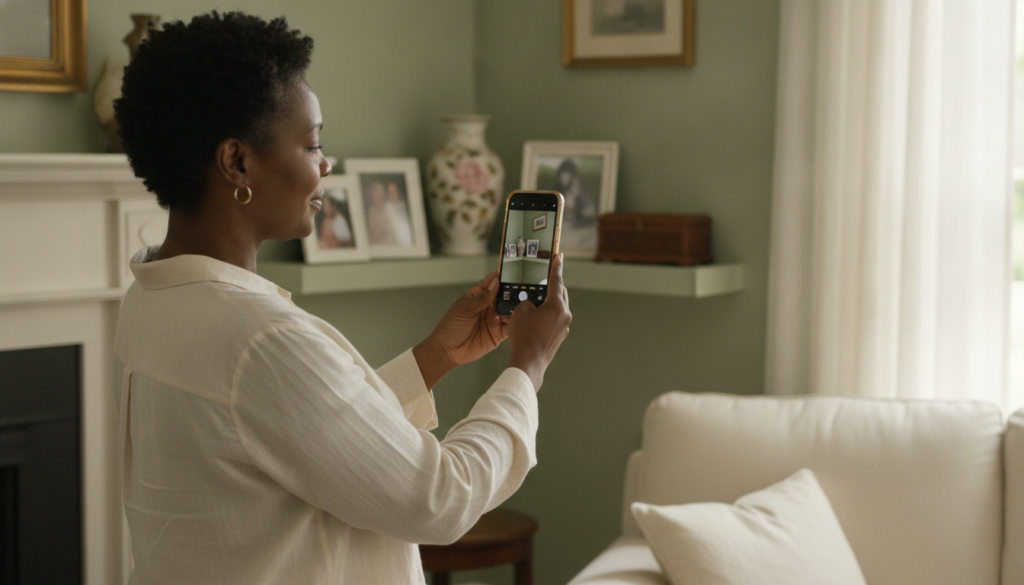
The short answer: To catalog family heirlooms, walk through your home one room at a time, photograph each sentimental item close up, and write down what it is, where it came from, and who you want to have it. Do this before anything gets divided, not after, because a will rarely names who gets the specific ring, the china, or the chair from the porch. Keep the finished home inventory in more than one place so it survives long after the walk-through is done.
Most people don’t get stuck on the will. They get stuck on the boxes in the attic, the jewelry in a dresser drawer, the recipe box nobody uses but nobody wants to throw out either. A will and a trust divide money and real estate. They almost never name who gets a specific photo album or a specific quilt. That decision needs its own record, starting with walking through the house, room by room.
What is a home inventory, and why does an estate need one?
A home inventory is a written and photographed record of what a household owns, built room by room, item by item, instead of from memory. For a federal estate tax return, the IRS requires a room-by-room itemization of household and personal items, with each article named specifically, though items in the same room worth $100 or less can be grouped together under current IRS rules. This requirement only applies to the small share of estates large enough to owe federal estate tax, since the 2025 federal exemption is roughly $13.99 million per individual, though separate state-level estate tax rules may also apply. If the paperwork side of estate planning is already handled, a home inventory of the actual belongings is usually still missing.
Before you start your home inventory
Bring three things into each room: a phone, a notebook or spreadsheet, and time nobody is going to interrupt. For each item worth tracking, write down what it is, roughly how old it is, where it came from if that’s known, and who it should probably go to. Then take the photo. The written entry and the photo belong together, not in two places that never get reconciled.
Go room by room to catalog family heirlooms
Work through the house in the same order every time, so nothing gets skipped because the energy ran out by the end:
- Living and dining rooms: art, furniture passed down, china, silverware, the rug nobody remembers buying
- Bedrooms: jewelry boxes, watches, letters, dresser-top photographs
- Kitchen: the recipe box, serving pieces only used at holidays, anything handwritten
- Attic, basement, garage, and storage units: collections, tools, seasonal decorations, anything boxed up and half forgotten
These are close to the exact categories the IRS names when it lists household and personal effects for an estate: jewelry, silverware, paintings, antiques, oriental rugs, and coin or stamp collections. If a room holds any of these, it’s worth its own pass.
How do you photograph items for your home inventory so the record holds up later?
Photograph the whole room first, then take close-up, multiple-angle photos of anything valuable or irreplaceable. A wide room shot alone can’t prove an item’s condition later, which is why insurers recommend close-up photos from multiple angles for anything worth real money. For estate purposes, value means what a willing buyer would pay a willing seller, with neither party under any compulsion to buy or sell and both having reasonable knowledge of relevant facts about the item, not what it’s worth sentimentally and not what it originally cost. That’s the IRS’s fair market value standard for household and personal effects.
Where do you write down who gets what in your home inventory?
A personal property memorandum is a separate, signed list that names who gets specific items like jewelry, art, or furniture, kept apart from the will itself so it can be updated without rewriting the whole document. This instrument, modeled on the Uniform Probate Code’s Section 2-513, is only legally binding in states that have adopted it or an equivalent statute, which covers a majority of US states, though the exact number changes as state laws are updated. It only covers tangible items, not real estate, intangible property, or, in most states, business property. In California, a personal property memorandum can direct up to $25,000 in total value, and any single item worth more than $5,000 falls outside its protection, though these thresholds are set by California’s current statute and can change. To count in California, the memorandum has to be referenced by an unrevoked will, dated, and either handwritten or signed by the person making it, describing each item and its recipient clearly enough that there’s no argument about which item, or which person, is meant. Pairing a will with a personal property memorandum is how the specific promises get kept alongside the legal document.
Why does a home inventory matter more than people expect?
According to the Allianz American Legacies Study, fulfilling last wishes and distributing personal possessions is more likely to be a family’s biggest source of conflict during a legacy transfer than dividing up money. That’s exactly the fight a room-by-room inventory, with a name attached to each item, prevents from starting.
What about pieces in your home inventory that are worth real money?
If a household’s jewelry, silverware, art, antiques, rugs, or collections add up to more than $3,000 in total value under current IRS rules, the estate’s executor has to attach a written appraisal from a disinterested expert, made under oath, to the federal estate tax return. This requirement, too, only applies to estates large enough to owe federal estate tax, not to every estate with valuable items, and it is separate from any state-level estate tax rules that may also apply. Even short of that threshold, it’s worth knowing that standard homeowners and renters insurance often limits jewelry theft coverage through a policy sublimit, commonly around $1,000 to $2,000 in total rather than a per-item cap, so a stolen or damaged heirloom above that limit won’t be fully covered without extra scheduled coverage. Insurers recommend a professional appraisal for anything valuable, re-appraised roughly every two to five years depending on the item, as pieces can appreciate, with the appraisal papers, receipts, and photos stored somewhere secure, like a safe deposit box or cloud storage.
Where do you keep the finished home inventory?
Keep the finished home inventory in more than one place: a digital copy on the phone, a copy in the cloud, and a copy emailed as a backup, so the record survives even if the original does not, in a fire, a flood, or a move. Once it exists, it belongs with the rest of a family’s important documents, not in a drawer only one person knows about, alongside wills, wishes, and messages kept in Myend’s end of life planning tools.
Frequently asked questions
What exactly counts as a household item for estate purposes?
The IRS defines household and personal effects broadly: jewelry, silverware, paintings, antiques, oriental rugs, and coin or stamp collections are named specifically, and any item like this needs to be itemized room by room on a federal estate tax return, with only low-value items under $100 each allowed to be grouped together.
Does a personal property memorandum replace the need for a will?
No. A personal property memorandum only works if it’s referenced by an existing, unrevoked will. It covers tangible items like furniture, jewelry, art, and collectibles, but not real estate, intangible property, or, in most states, business property. It’s a companion to an end of life will, not a substitute for one.
What happens to heirlooms if there’s no will at all?
Without a will, there’s no document for a personal property memorandum to attach to, so specific items don’t automatically go to the people named in a family’s informal understanding. Instead, distribution follows the state’s intestate succession rules, which is exactly the gap a room-by-room inventory and a written will close before it becomes a problem.
Do I need a professional appraisal for everything on the list?
No. An appraisal is only required for federal estate tax purposes once a household’s jewelry, art, antiques, and similar valuables add up to more than $3,000 in total. For anything below that but still worth insuring, a professional appraisal renewed roughly every two to five years depending on the item is what insurers recommend to back up a claim.
This article is general information, not legal, tax, or financial advice. Rules for wills and personal property memorandums vary by state. Consult a licensed attorney in your jurisdiction before relying on any of it.
Last reviewed: August 2026